Project Summary
-
Program:
Global Healthcare Innovation Lab (Babson College X HELP Hospital)
-
Period: August - December 2024
-
Role: Project Lead
Led an interdisciplinary team to improve pre-surgical patient communication at a Brazilian hospital, reducing rescheduling rates by designing and implementing a WhatsApp-based reminder system, brochure, and AI-generated video.
Overview
As the graduate student team lead in an international, interdisciplinary project, I collaborated with undergraduate students from Brazil and the U.S. to improve patient communication and reduce surgery rescheduling rates at a public hospital in Brazil. Our focus was on redesigning the hospital’s pre-operative communication flow using low-cost, scalable tools such as WhatsApp reminders, an educational brochure, and an instructional video.
The project required not only analytical thinking but also strong project management and cross-cultural leadership skills, balancing differing team dynamics, languages, and stakeholder expectations in a real-world healthcare environment.
Objective
-
Reduce surgery cancellations by improving patient understanding and adherence to pre-surgical requirements
-
Build a scalable communication prototype tailored to both patients and hospital staff
-
Facilitate collaboration across countries, time zones, and disciplines while aligning stakeholder needs
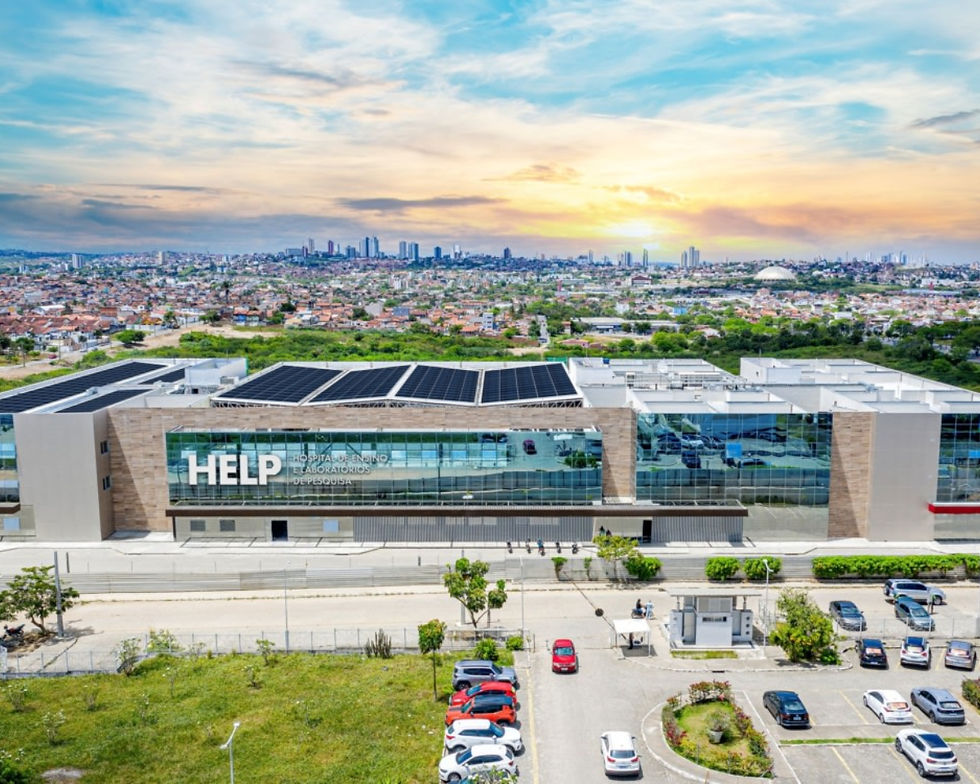
Global Healthcare Innovation Lab
Integrated Impact
-
Demonstrated how global collaboration can address localized public health challenges using simple, digital-first tools
-
Enhanced hospital staff understanding of where communication gaps occurred, especially among elderly and low-literacy patients
-
Highlighted the value of empathy-driven design and cross-functional leadership in healthcare innovation
Tools & Methodologies
To address the challenge of improving pre-surgery communication at HELP Hospital, we applied a multidisciplinary and user-centered approach involving the following tools and methods:
-
Journey Mapping: Used to visualize the entire patient experience from clinic visit to surgery day, identifying communication breakdowns and opportunity points.
-
Fishbone Analysis: Helped identify root causes of surgery rescheduling, categorizing them by People, Process, Technology, and Environment.
-
QFD Matrix (Quality Function Deployment): Prioritized stakeholders’ needs to align prototype features with critical requirements from both patients and staff.
-
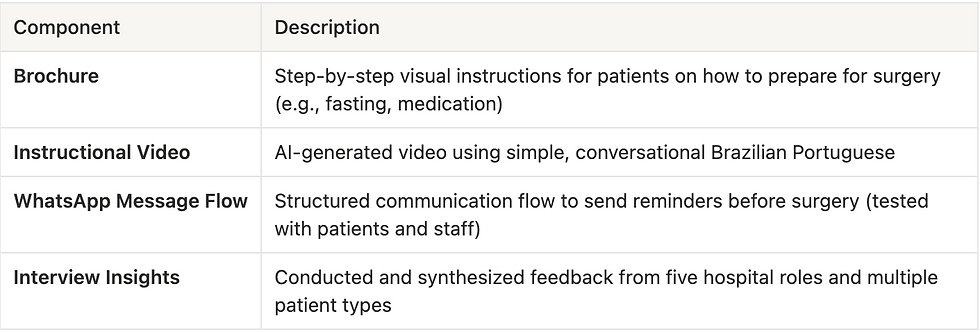
Prototyping (Brochure, WhatsApp System, Instructional Video):
-
A printed brochure outlining key steps and documents needed.
-
A WhatsApp-based messaging workflow, improving timing and clarity of reminders.
-
A video prototype created using Synthesia AI to explain instructions in a visual and accessible way.
-
-
Stakeholder Interviews: Conducted structured interviews with 7 stakeholders including patients, doctors, nurses, and administrative staff to evaluate usability and effectiveness.
-
Satisfaction Metrics: Quantitative and qualitative feedback were collected and analyzed to assess clarity, usefulness, and perceived patient empowerment.
These tools not only shaped the solution design but also demonstrated the project team’s ability to integrate public healthcare knowledge with digital communication strategies, bridging global management skills with hands-on implementation.
Reflection
This project challenged me to lead without authority, coordinate across cultures and disciplines, and design not just for usability, but for adoption within real-world public sector constraints. Coordinating between multiple stakeholders, including the hospital, school, supervisors, and a diverse team across two countries, also proved that the project was far more complex than expected.
Despite some challenges, I’m proud of how we stayed committed to the goal and to one another. Through persistence and transparent collaboration, we created a solution that both addressed real patient needs and respected institutional realities.
By balancing analytical rigor with soft skills, I experienced firsthand what it takes to drive innovation in resource-constrained, high-stakes environments, skills I aim to bring into future global roles at the intersection of technology and public impact.
This experience also taught me that effective project leadership, especially in global and public healthcare settings, isn’t just about execution. It’s about holding space for diverse perspectives, adapting quickly, and building structures for collective progress. These are the lessons I will carry forward into any role at the intersection of innovation, impact, and global collaboration.
Key Deliverables
Leadership in a Global Healthcare Setting
-
Organized and aligned a multicultural team (U.S. & Brazilian students) across weekly milestones
-
Defined clear roles and deliverables, ensuring all interview data, prototype drafts, and final materials were shared transparently
-
Led communication with the hospital’s champion and multidisciplinary medical staff (psychologist, pharmacist, nutritionist, nurses)
-
Created a instructional video and simplified brochure using accessible language and visual cues
-
Resolved challenges such as unclear information flows, internal staff disengagement with WhatsApp, and lack of patient response tracking
Approach & Structure
